
Logistics companies are competing for talent with other sectors as well as with competitors. Although there are exceptions, logistics continues to have limited representation across some demographic groups. It has an older workforce profile, particularly in transport. Men continue to be significantly over-represented in many logistics’ roles. Is this profile the result of the sector’s lack of attractiveness or down to longstanding cultural norms and workplace cultures?
When logistics businesses discuss workforce shortages, the conversation usually focuses on vacancy numbers and driver availability.
Yet some of the biggest threats to future workforce stability are hidden in plain sight.
Across transport, warehousing and logistics, ageing workforces, limited diversity and emerging digital skills gaps are creating long-term risks for productivity, succession planning and business growth.
The question is not simply whether logistics can fill today's vacancies. It's whether it is building a workforce capable of meeting tomorrow's operational demands.
Gender Diversity in Logistics
If I did a pie chart of the gender mix of HGV drivers, you would scarcely be able to see the sliver that would represent women (0.8% in 2025)[1]. What’s perhaps more surprising is the extent to which women remain significantly under-represented for fork-lift operators (1%), van (9.2%) drivers and warehouse operatives (higher, but still only 1 in 5 workers), all of which offer opportunities to work in roles with shorter hours, getting home every day.
I’m not going to write further on gender mix here as Women in Logistics published a report, authored by me, on the proportion of women in various roles and companies, which will be updated in 2026[2]. And a previous insight piece for Blue Arrow was specifically on the Equality Action Plans which will be required from larger companies by the UK government in the future.[3]
Why does workforce diversity matter in logistics?
Workforce diversity matters because logistics cannot afford to recruit from a narrow talent pool while labour shortages, rising costs and service pressures continue. For hiring managers, broader attraction is not simply a fairness issue: it can improve access to candidates, strengthen retention, support succession planning and help teams reflect the customers and communities they serve.
Employers that understand where their workforce is under-represented can target attraction and engagement activity more effectively, rather than relying on the same shrinking groups of candidates.
Workforce Ageing and Future Talent Pipelines
For logistics operators, workforce ageing creates succession planning risks, increases dependency on a shrinking talent pool and can slow adoption of new technologies that are becoming essential for operational efficiency.
We all know about the age profile of HGV drivers, in fact there’s a graph in the previous insight piece showing just what a problem that is, particularly for the drivers of vehicles at the smaller end of those requiring vocational licences. But it’s an issue in other parts of the industry too.
While it may be no surprise that Directors in logistics, warehousing and transport are on average more than 3 years older than Managers in transport and distribution (on the basis that you have to work your way up to the top), those Transport managers are themselves on average 2 years older than the ONS category for Managers AND directors in retail-and-wholesale and wholesale. This difference in age profile can be seen quite clearly in the graph below – retail-and-wholesale has more Millennials, resulting in a much flatter age profile for managers and directors, almost certainly healthier for the future well-being of that sector.
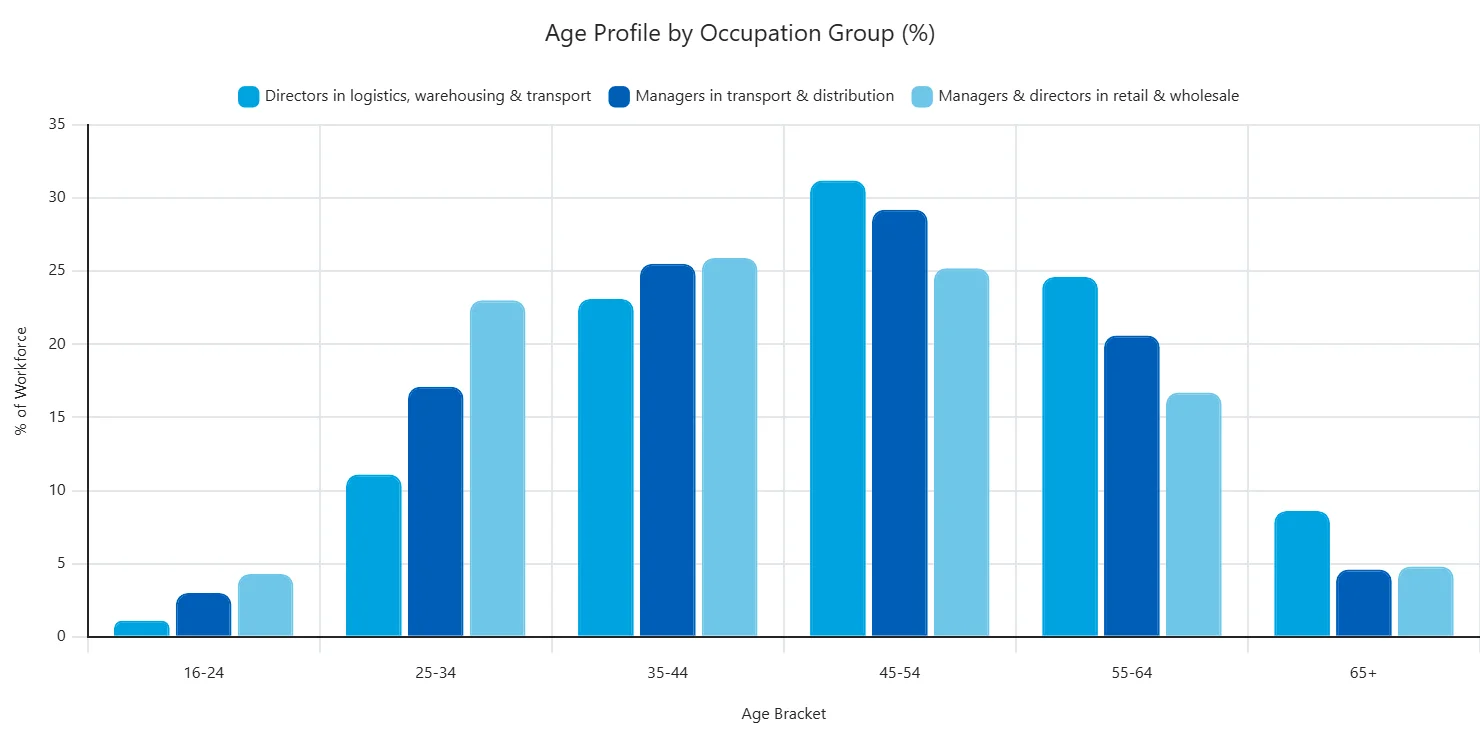
And it needs to be borne in mind that these age profiles come from the census which was carried out in 2021 – we’re now in 2026 and all those people are five years older. These are a combination of people working in head offices and large 3PLs as well as the many SMEs across the industry.
This age profile across various occupations in transport results in at least two different problems: a digital skills gap and the longer-term sustainability for these businesses.
What risks does an ageing transport workforce create?
An ageing transport workforce creates several practical business risks: more retirements in critical operational roles, thinner succession pipelines, greater reliance on experienced people who are increasingly hard to replace and a potential slowdown in technology adoption.
For operators already managing cost pressure, this can make recruitment more reactive and expensive. The earlier businesses identify where age concentration exists, the easier it is to build future talent pipelines before knowledge gaps become operational gaps.
Ethnicity
Different occupations have different ethnicity profiles. The data shown in the graph is from the 2021 census of England and Wales and gives us an overall snapshot of those profiles.4 HGV drivers have a very low proportion of people from minority ethnic backgrounds represented in comparison with the general working population, while delivery and courier drivers tend to have a larger proportion of Asian workers and warehouse operatives a larger proportion of Black workers than the general working population.
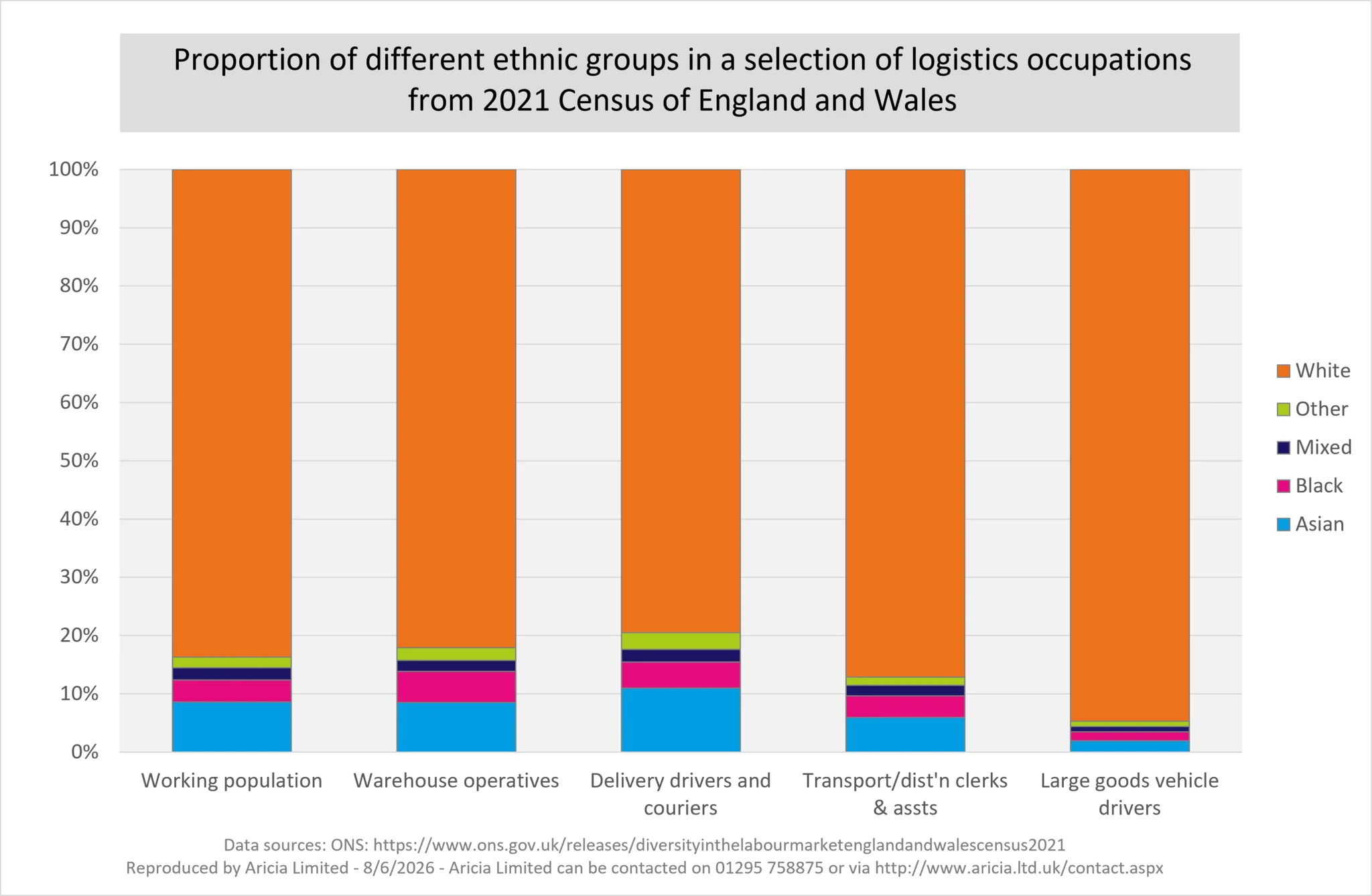
Although the graph shows that transport clerks have a higher proportion of white workers than the general working population, by only plotting the high-level categories of ethnicity, the graph doesn’t demonstrate that transport clerks were more than 2.5x likely to be ‘Other white’ than the general working population, probably mainly mainland Europeans.
As well as not getting the full benefits of a diverse workforce, logistics also runs the risk of dissatisfaction in the ranks if lower-paid temporary and contingent roles are disproportionately filled by people from minority ethnic backgrounds and higher-paid roles over-index on representation of White workers.
Many logistics businesses recognise they have workforce challenges but struggle to quantify them.
Understanding where demographic risks exist, whether that is age concentration, diversity gaps, retention challenges or succession weaknesses, is often the first step towards improvement.
Representation alone is not enough. Organisations also need inclusive cultures where people from different backgrounds can thrive, progress and build long-term careers. Understanding employee experience is just as important as understanding workforce demographics.
Blue Arrow's Diversify workforce analytics tool helps employers benchmark workforce demographics, identify engagement disparities and uncover opportunities to broaden talent attraction strategies before workforce risks become operational problems.5
What skills will logistics businesses need over the next decade?
Over the next decade, logistics employers will need to combine operational experience with stronger digital, data and compliance capability. Demand is likely to grow for people who can use transport management systems, warehouse management systems, automation, workforce planning data, AI-enabled forecasting, cyber-security awareness and decarbonisation reporting.
This means recruitment plans need to look beyond immediate vacancies. They need to identify where the business is at risk of missing future-critical skills and how those skills can be developed, borrowed or recruited.
Digital Skills Gap
Back to age profiles. Commissioned by the Road Haulage Association in conjunction with Women in Transport, and published at the end of 2025, “Navigating Generational Change: Building a Future-Ready Transport Workforce”, this report has forewords by both Richard Smith, MD of the RHA and Jo Field, the Chair of Women in Transport.6
Jo says in her introduction: “While ethnicity and gender have rightly been at the forefront of the diversity conversation, age is still one of the most overlooked yet consequential parts of it.” And Richard has said: “By understanding how different generations view work, skills, and career progression, we can create strategies that attract, retain, and develop talent across every age group.”.
And we desperately need to do that if, as an industry, we are to maximise benefit from the digital revolution. Much of the logistics sector is made up of, not just SMEs, but micro companies, with less than 10 employees. The profile of these small companies can feel quite different to the large 3PLs.
In the smaller companies, it’s much more likely that there will be family members, long term staff, low turnover and former drivers running the office - decades of good operational experience. Meanwhile, the white-collar staff in mega-3PLs, in planning and management, are more likely to come from different backgrounds – school leavers, apprentices and early-career professionals, never been drivers, but coming into office with digital skills.
Last time the ONS updated its list of Standard Occupation Codes from SOC 2010 to SOC 2020, a number of different job-types were added, some of which are relevant to the digital skills gap including the roles of Data entry administrators and Cyber-security professionals. Back in 2010 there just weren’t enough people doing these sorts of roles to be worth counting them as a separate category.
The ONS has recently carried out a consultation on new roles or sub-roles that it ought to include in the next SOC update. In some ‘member only’ content, the Logistics UK response included: Logistics Systems Manager, Logistics Data Analyst and Automation Engineer as well as roles related to decarbonisation and compliance.
Some employers may perceive younger workers as carrying greater training or retention risk, and they definitely want more flexibility, but if you don’t employ them, you won’t be bringing these skills into your organisation.
Long-term workforce sustainability
Going back to the question I posed at the start of this piece, things have changed during the time I’ve been in the industry, and I do believe that the demographic profile of the logistics industry, and particularly transport, is the result of the sector’s perceived attractiveness as a career destination, and positive visibility, at least as much as it is down to legacy perceptions, cultural barriers and traditional ways of working, although these do still definitely exist.
How can logistics employers attract younger workers?
Attracting younger workers will mean making logistics more visible, more accessible and easier to understand as a career choice. That includes clearer career pathways, apprenticeships, entry-level routes into transport and warehousing, technology-led roles, practical flexibility where possible and employer branding that shows the sector as modern, essential and progressive.
For many businesses, the opportunity is to start positioning logistics as a career with progression, purpose and future-facing skills.
The so-called ‘war for talent’ is also about retaining employees as well as attracting them, both those who are doing the hard work of physically delivering the nation’s food, clothes and everything else, and the next generation of logistics professionals who will help to continue to develop the future world.
The introduction to the previously mentioned RHA and Women in Transport report states: “The UK transport sector is standing at a demographic crossroads. Age is not just a number in this industry – it is a structural challenge that affects safety, skills, service delivery, and long-term sustainability.”.
I couldn’t have put that better myself. Remember, logistics companies are competing for talent with other sectors as well as with competitors.
What This Means for Logistics Employers
Forward-thinking logistics businesses are increasingly focusing on:
- Workforce succession planning.
- Attracting younger talent into transport and warehousing careers.
- Expanding access to underrepresented talent pools.
- Building digital capability alongside operational expertise.
- Using workforce data to identify demographic risks before they become labour shortages.
Organisations that address these challenges now are likely to gain a long-term competitive advantage in labour availability, retention and operational resilience.
The workforce challenge is no longer simply about filling vacancies.
It’s about ensuring the industry remains attractive to future generations, developing the digital skills needed for an increasingly technology-enabled supply chain, and creating sustainable talent pipelines that support long-term growth.
Businesses that continue recruiting from the same shrinking talent pools may find workforce shortages becoming harder and more expensive to solve. Those that broaden their attraction strategies, invest in workforce planning and understand their demographic risks will be better placed to secure the talent needed for the decade ahead.
In a highly competitive labour market, workforce sustainability may become one of the most important competitive advantages a logistics business can build.
Key Logistics Workforce Facts
0.8%
of HGV drivers are women.
Predominantly Male
Warehouse workforces remain largely male.
Older Workforce
Transport managers are generally older than comparable retail-and-wholesale management populations.
Growing Demand
Need for digital and automation skills continues to increase.
Succession Risk
Many logistics SMEs face increasing succession challenges as experienced leaders approach retirement.

Kirsten Tisdale FCILT, Director – Logistics Consulting, Aricia Limited
Data Sources Include:
[1] https://www.nomisweb.co.uk/ - Annual population survey
[2] https://www.womeninlogistics.co.uk/shop
[3] https://www.bluearrow.co.uk/recruitment-solutions/industry-insights/equality-action-plans-logistics/
[4] https://www.ons.gov.uk/releases/diversityinthelabourmarketenglandandwalescensus2021
[5] https://www.bluearrow.co.uk/recruitment-solutions/diversify/
[6] https://www.rha.uk.net/Portals/0/Campaigns/Publications/RHA-Intergenerational-Workforce-White-Paper2025.pdf
Building a Future-Ready Logistics Workforce