Different sizes, different challenges. How company size shapes costs, cash flow, fleet decarbonisation, technology, compliance and talent in UK road freight and logistics.
The challenges facing different parts of the logistics sector vary. Some, such as fuel and energy prices, are common to large and small companies alike. In other areas, the challenges can be very different.
This article examines how company size affects the capacity to invest, talent pipelines, digital readiness, fleet decarbonisation and compliance management, among other issues.
UK logistics company size: what the data shows
First though, what do the ‘demographics’ of companies in the industry look like, as opposed to the demographics of its people?
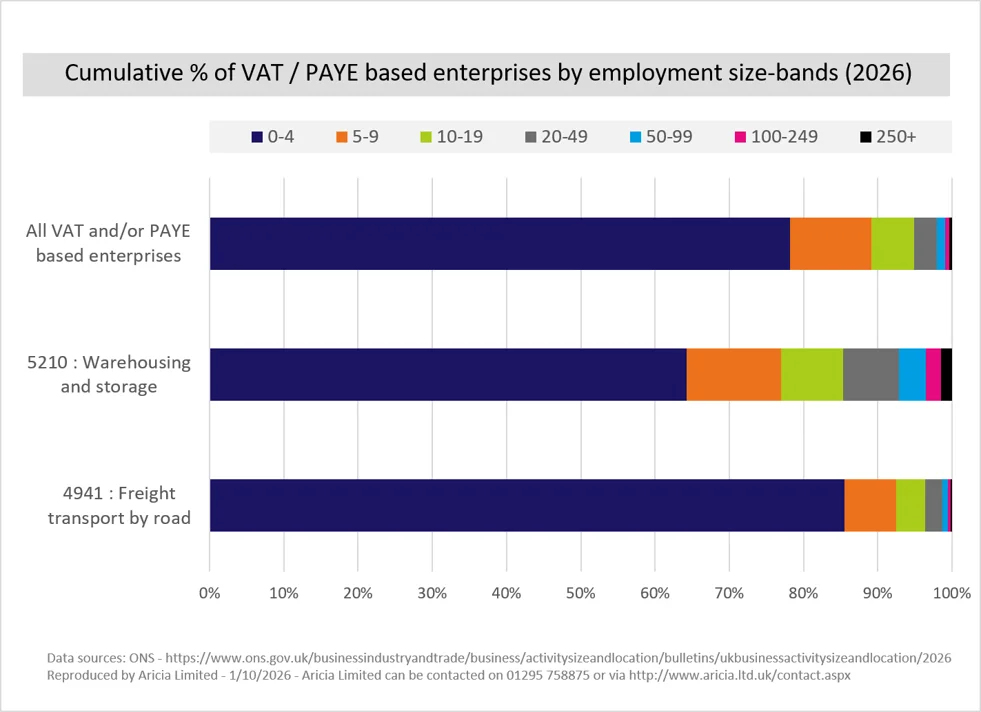
This graph shows the proportion of companies in different employment size bands:
- The top bar shows the profile of all VAT and/or PAYE enterprises and demonstrates the sheer number of SMEs (Small & Medium Enterprises) and how few large companies exist.
- The middle bar shows the profile of Warehousing companies – proportionately fewer very small companies with less than 5 employees, but with the number of companies with over 250 workers being easier to spot on the far right-hand side.
- And the bottom bar shows Road Freight businesses, with a larger proportion of tiny companies and a lower proportion of really large ones (too small a percentage to be seen on the graph).
What you can’t see on the graph is that there are nearly eleven times as many (10.8 times – 45,785 versus 4,250) companies in Road Freight as there are in Warehousing. The number of companies with over 250 employees for Road Freight is 85 and for Warehousing 65 but representing a much lower proportion of companies in road freight and, hence, invisible on the graph. Employees in the industry are spread across a wide range of company sizes. These are very rough calculations, but the large dark-blue sections on the left probably represent about one in seven logistics employees working in companies with fewer than five employees. That is not insignificant. Equally, there are likely to be more employees in the black sections on the right, representing the largest companies, than in all the other logistics companies combined.
So, what challenges do companies of different sizes across the logistics sector face?
Small hauliers: the operational reality
Costs, cash flow and investment
I’m going to start with diesel cost, as it is such a hot topic as I write this piece. Many hauliers, both large and small, operate on razor-thin margins. If you’re a smaller haulier with just a few trucks, you’re more likely to depend on ‘public’ fuel supplies, filling up on the job rather than using a bulk supply back at base. You certainly won’t have a treasury department experienced in hedging!
That inability to absorb spikes in fuel costs can also worsen cash flow. You pay for fuel as you do the job, possibly on credit, and then wait longer to be paid by a 3PL or direct client.
I believe there’s a serious risk that some hauliers will decide to sell up and leave the industry and that we won’t just have a situation where drivers don’t fancy working in the industry but that smaller hauliers won’t want to either.
Why would you want to invest, assuming you had the readies? Inheritance tax threats, both real and scare stories, may be driving owners to make decisions based on tax liabilities rather than long-term business considerations. And younger family members may not wish to take on the risk.
The biggest reason, alongside envisaged growth, is probably vehicle replacement, with customer pressure to reduce carbon and other emissions. You may be buying second-hand, in which case you won’t have much choice apart from diesel, but with new tolls and restrictions for various cities that may restrict what work you can take on at some point in the vehicle’s life.
But even if you were intending to buy new, the size of step has changed if you’re looking at BEVs (Battery Electric Vehicles), and it’s your company that’s having to take the upfront cost …and risk! Possibly better to stick with diesel for the moment, certainly easier.
Fleet decarbonisation and compliance
A larger company buying its first EV can regard it as an experiment, perhaps even sponsored by a client. But for a smaller operator, that vehicle may represent a significant proportion of the fleet. It is a big decision that cannot afford to be wrong.
There’s also all the change that’s required – electric vehicles require charging facilities, different maintenance requirements, maybe different schedules… At the RHA Driving The Future Forum at The Vox in September, Anthony Tattersall, MD of Darcica Logistics, a company with an Operator’s Licence for 20+ vehicles, was talking about the number and width of elements of learning with respect to electrification for fleet charging.
So, diesel might continue to suit you more, because of the limited supply of charging points on the run and the need to spend time to charge. Commercial Motor reported that: “Europe’s leading truck manufacturers have called for the EU’s 2030 CO2 compliance deadline to be delayed by three years, warning that the conditions needed for operators to switch to zero-tailpipe-emission trucks are developing too slowly”,[1] because of the lack of suitable heavy-duty charging points in mainland Europe.
However, at some point, the move away from diesel will need to be made. It is not only about financial and operational considerations, but also responsibility. The implications extend beyond the fleet and its maintenance to the driving workforce and the way the operation is managed. Ensuring compliance or managing IT can take nearly as much effort for a small fleet as for a large one.
Technology and digital readiness
Customer demands will require even the smallest company to adopt some technology, including – PoDs (proof of delivery), vehicle tracking... Some telematics will be available because they come with the truck.
Costs, both real and perceived, can prevent smaller operators from adopting technology that does not contribute directly to the operation. However, much cloud technology is now available on a per-seat basis. Cyber-attacks remain a genuine risk.
But this is one of those moments when I take my head in my hands! Research, published in the summer and based on a survey conducted across Road Haulage Association members and OneAdvanced customers, found that what was referred to as the ‘data gap’ is very much a small-fleet issue: 44% of micro fleets (1-5 vehicles) rely purely on intuition for strategic decisions.[2]
Where small companies do have an advantage is that they can sometimes be more agile. But it depends on who’s available to implement.
Staffing, skills and succession
Small hauliers may well be using family members or ex-drivers to manage the office – lots of lived experience, low turnover, more traditional planning skills. This can give succession planning risks, increases dependency on a small talent pool and can slow adoption of new technologies. And as discussed above, those technologies can be physical ones around fleet electrification as well as digital ones.
Micro-companies will struggle to cover the full range of skills required because a great deal is expected from very few people. If you need a first aider on site, someone with one specialist skill and someone with another, those responsibilities fall on the same small team.
And they may not be able to pay to attract ‘top talent’. As seen above, costing and financial planning skills may be in short supply along with negotiation skills – the ability (and power) to negotiate with both customers and suppliers.
What those family and micro-businesses will have is hearts and souls invested in the business!
Large logistics providers: the operational reality
Profitability, purchasing power and outlook.
Razor-thin margins are not just the domain of the small haulier – nearly 1 in 5 companies in Motor Transport’s Top 100, which covers the very biggest 3PLs (Third party logistics providers) and transport companies, were loss-making last year[3]. And that’s not an atypical figure.
Where a larger logistics provider should benefit over smaller companies is in purchasing bulk fuel and other resources. And from having a more diverse customer and operational base including, for example, warehousing and fulfilment as well as being more likely to have contracts for dedicated commitments. However, a big company is just as likely to suffer extended payment terms and corresponding cashflow issues.
Where we saw, in looking at the smaller companies, that nearly half of micro fleets rely purely on intuition for strategic decisions, these larger logistics providers will have whole teams devoted to financial planning, carefully modelling not just expected profit but also ROI (Return on investment), EBITDA (earnings before interest, taxes, depreciation, and amortisation), along with all sorts of other ‘alphabet soup’.
However, these larger companies also must answer to someone other than themselves – their decisions will be subject considerations such as the stock market or the requirements of private equity investors. Ironically, they may not be able to take as long a view as a family company.
Fleet sustainability and compliance reporting
Like smaller hauliers, the large 3PLs will want to grow, will need to replace vehicles and at the same time consider the environmental impact of their decisions.
The larger fleets are more likely to be able to experiment and adopt different routes to that sustainability. HVO (Hydrotreated Vegetable Oil – synthetic, renewable diesel made from waste-derived oils and fats) is an easier option for those with bulk tanks and the ability to refuel on own sites.
And, yes, they can experiment with EVs, but the evidence now is that they are holding back. In 2025 DfT (Department for Transport) figures showed there were just over 3K BEVs over 4.25T registered for road use[4]. And data published by the SMMT (Society of Motor Manufacturers & Traders) shows that just 90 more HGV ZEVs (Zero emission vehicles i.e. BEV or hydrogen fuelled) were added by the end of Q2 2026[5]. These two figures are across all fleets, both large and small.
Analysis I carried out using the Motor Transport fleet data showed that the larger companies appear to be reducing the number of HGVs in total (regardless of fuel type) in their fleets, possibly looking to reduce costs because of the state of the economy and/or to compensate for additional costs. See a recent post on LinkedIn where I highlight the reduction in fleet sizes in recent years.
And of course, the larger companies are more likely to have larger warehouses and will have to find and operate sustainable premises which, going to back to costs for a moment, will almost certainly carry an increased bill for business rates.
If the burden of compliance in smaller companies may fall on a single pair of shoulders, large companies have increased reporting requirements. Larger companies not only have to submit carbon footprint reports, but they also have increased financial disclosure requirements including around payment practices, and Gender Pay Gap data and even wider equality reporting going forward.
Digital readiness and system integration
Large companies have the purchasing power and teams needed to buy and implement IT systems. They tend to be more aware of cyber-attack risks, although recent experience has shown that any company can be exposed to hacking. Think JLR and M&S. Larger companies also have data pools that can support machine learning and AI systems.
But large companies may have legacy systems (they started using IT in the days of AS400s and ‘green screens’) and may have more to integrate across multiple global sites across multiple large and demanding customers, which can result in complication, to put it mildly.
The RHA/OneAdvanced survey, referred to earlier, reported that: “91% of hauliers operate below seamless integration - and it does not improve with scale. Enterprise fleets are no more integrated than medium ones…”.
Talent pipelines and workforce mobility
The staffing of a huge multi-site, multi-country 3PL is a different game to staffing a single location company. If you have a head office, you have another layer of cost, but that’s what’s required.
You may well have a younger profile of staff in the traffic office, with early-20s, ex-6th-formers with good modern planning skills but little experience of the job being done by drivers out on the road. But, again going back to costs, those staff may now be costing more as a result of minimum wage increases.
You may require specific, deep expertise. Someone I met last week is advising young people to consider training as high-voltage engineers because it is an area of real and continuing shortage, with prospective employers beyond logistics. People management and many traditional skills will continue to be needed too.
No criticism of anyone or any company intended, but it seems as if the only way people can be promoted is by moving companies. As a multi-site operator, you will expect your staff to be more mobile, but in turn that means you are probably recruiting people with less commitments to your individual business.
Small vs large logistics operators: common challenges and critical differences
You could accuse me of generalisations in this piece, but I think many in the road transport industry will have recognised the picture I’ve painted.
Returning to the graph and statistics at the start, more employees work in the very largest logistics companies, but micro-companies are far from insignificant and are very much needed. The common themes across small and large logistics companies are cost, cash flow, the step change required to invest in EVs, uncertainty over off-site charging availability and the need for new skills.
Where are the differences? A smaller haulier cannot afford to experiment with its next vehicle purchase. Introducing a new type of vehicle requires knowledge across many new areas, as does implementing new IT. The sheer range of investments and number of skills that one or two people need to cover in a smaller company can be overwhelming.
3PLs may face larger turnover of staff compared with small companies because those large companies may be more likely to be regarded as a stepping stone, but the significance to a smaller company of losing a key member of staff will be much greater.
A large 3PL is much more likely to be getting much of its income from running huge fulfilment warehouses. And while I don’t believe any 3PL is going to ‘get out of road freight’, there is a real risk that smaller hauliers will, depending on the ages and attitudes to investment in that business. At the same time, the 3PLs seem to be relying on the smaller hauliers being there.

Kirsten Tisdale FCILT, Director – Logistics Consulting, Aricia Limited
Sources
1. https://www.commercialmotor.com/news/article/truck-makers-demand-three-year-co2-delay
2. https://www.rha.uk.net/news/news/detail/new-research-from-the-rha-and-oneadvanced-finds-91-of-uk-hauliers-stuck-beneath-an-integration-ceiling
3. https://motortransport.co.uk/top-100/2025
4. https://www.gov.uk/government/statistical-data-sets/vehicle-licensing-statistics-data-files
5. https://www.smmt.co.uk/vehicle-data/heavy-goods-vehicle-registrations/
Build the Skills Your Logistics Operation Needs Next