
The Future Logistics Workforce: Solving Capability Gaps, Attracting Talent and Building Skills for Growth
Logistics companies are competing for talent with other sectors as well as with direct competitors. But this is no longer simply a recruitment issue. It calls for a different approach to attraction, workforce planning, training and retention. All of this must happen while businesses continue to run day-to-day operations and respond to decarbonisation, digitisation, automation and AI.
And supply chain disruption is increasingly becoming a permanent management challenge rather than a temporary event, impacting on cost and service - inflation in the somewhat boringly named ‘Other transportation support services’, which will include freight forwarding etc, was up 25% against the year in Q2 - reflecting the rearrangement of all sorts of freight movements as a result of the US war with Iran.
I increasingly question whether logistics has a labour shortage problem at all. The evidence often points to something more complex: an attraction, accessibility and capability problem. These capability gaps have been made worse by the historically low profile of logistics.
The various trade associations in the sector must be congratulated, as the new government does finally look to have understood the importance of our industry. We now have a Minister for Aviation, Maritime & Logistics, although his responsibilities still don’t appear to actively express involvement in the whole UK supply chain. In this role Kier Mather is responsible for: aviation, Heathrow expansion, maritime, international, security and resilience, freight and borders (grouped together in the listing), and sustainable aviation fuel.1
Employer positioning
Logistics employers need to use this raised profile to support attraction and retention, close capability gaps and fill today’s roles. But workforce strategy must begin with the business plan. What does your organisation want to achieve in one, five and ten years? Which outcomes, roles and skills will make that possible? Which positions would constrain growth if they remained unfilled? Then ask yourself whether your current workforce strategy reflects those answers. Workforce strategy is increasingly business strategy.
In terms of positioning your company in the jobs market, think about what motivates younger people:
- What are you doing that helps improve and protect the planet they will continue to live on? Talk plainly about reducing energy use, emissions, pollution and waste, and contributing to local and global communities.
- What are you doing to genuinely support people as well as pay them? Different groups need different things. Younger people may value mental health support, those in physically demanding roles may value physiotherapy, and drivers may benefit from access to healthcare outside standard hours, unable to join the ‘8am scramble’ for same day appointments as they are out on the road driving.
- What shows people that their aspirations matter? Demonstrate how a seasonal warehouse worker might build skills, become a shift supervisor or move into an office-based role, using real examples and ambitious but credible timescales.
And excite them. I see all sorts of cartoons about logistics: never sleeping, permanently wired and being pulled in every direction. They are funny, with more than an element of truth, but they miss the other side of the story: helping to feed the nation, moving essential products from around the globe and using modern technology, from data-led decision tools to cobots that support physical work. Businesses often showcase automation to customers and investors but forget that it can also strengthen their employer proposition.
But while aiming to attract younger people, don’t forget other demographics. The most recent insight article that I wrote for Blue Arrow looked at some of the demographics in logistics, so I’m not going to spend too much time on diversity in this piece, but broadening the talent pool is an operational necessity. Consider that only 21.2% of apprenticeship starts were by people under 19 years of age.2
While we’re talking about positioning and attraction, it’s worth saying that the route for many into the sector will continue to be through what I call the ‘volume’ roles: warehouse operatives, courier / van drivers and HGV drivers.
It may be helpful to reposition these roles as routes into supply chain careers, but don’t oversell the concept. Plenty of talented people have not found the school environment conducive to doing their best. Logistics has often been good at spotting capability and helping people develop. But many operations are, by definition, pyramids: we need more doers than managers. Talk about progression, skills and choice, but be honest about what is realistically available. Not everyone wants management, and a credible workforce proposition should value essential frontline expertise in its own right.
The idea of HGV driving is attractive
Although this piece is about wider logistics roles, I make no apologies for a quick focus on drivers. They are very often the most visible part of the logistics workforce, both physically (out and about in business and the community delivering the goods) but also in writing because of the ongoing driver ‘shortage’.
Actually, there is no difficulty attracting people to the idea of HGV driving - there are masses of aspirant and once-aspirant HGV drivers who went to the effort and expense of having a medical and getting a provisional licence, but who haven’t pursued this for whatever reason.
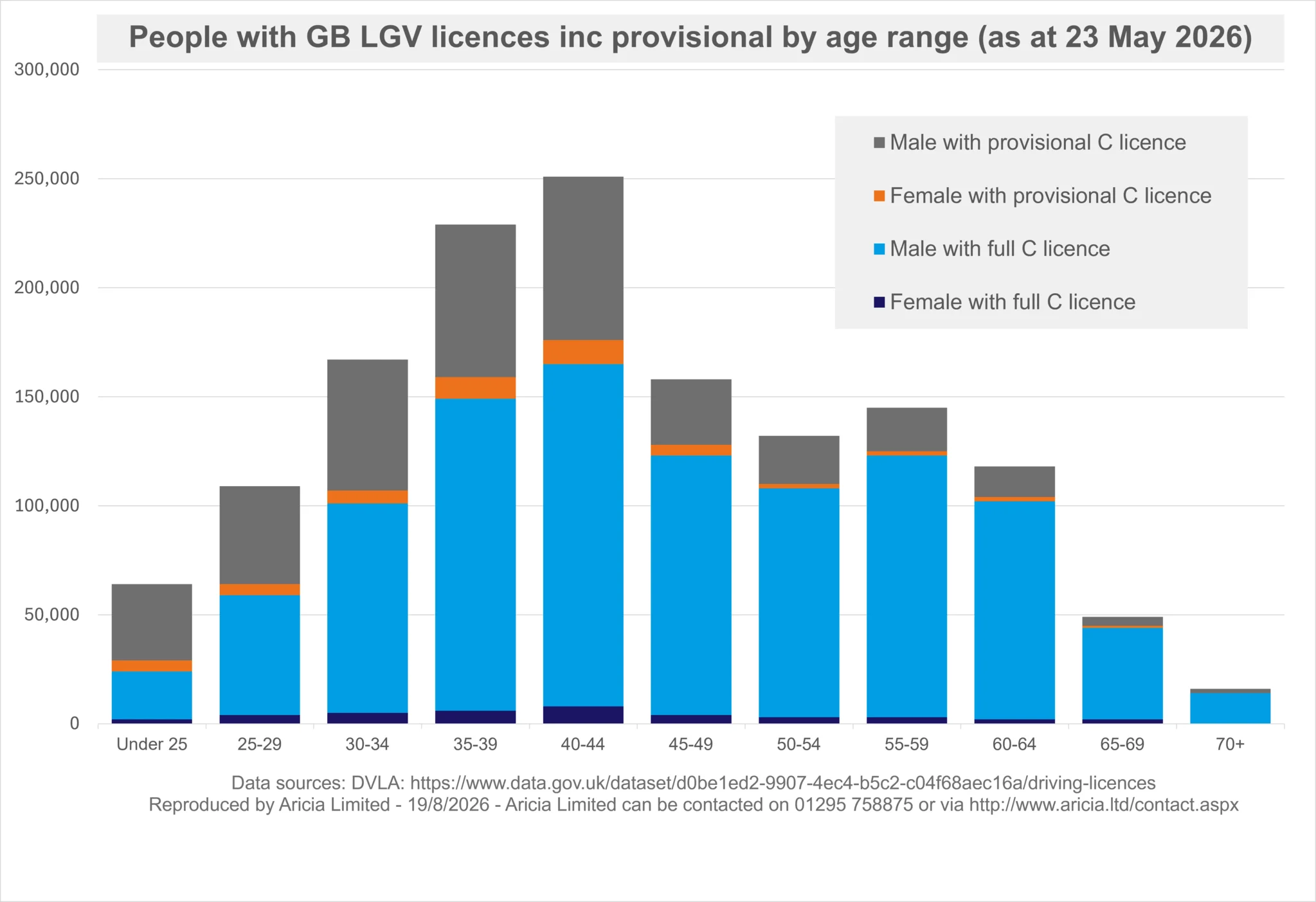
The graph shows in the two shades of blue, that there are nearly 975K people with full C licences, nearly two-thirds of whom also have CE licences. But what the graph also shows in the orange and grey bars is that there are a substantial number of people with provisional C licences. Many of these are in the under-45 age bracket - there are nearly 350K of them.3
Let me say it again and very precisely: in May this year there were 346,581 people with provisional Class C HGV licences who were under 45 years of age. Good news!3
Some of those will be bus/coach drivers but the majority will not be - we know from some analysis carried out by DVLA that there are over 322K people across all the ages who have provisional LGV licences, but no full PCV. Some may be working as C1 drivers, but we know that there are less than 4K of them in the under-45 bracket. NB That 350K doesn’t include C drivers who want to step-up and are holding a provisional CE licence, but it will include more recent applicants who can go straight for CE but will also have provisional C licences as a matter of course.3
Why so many people with provisional HGV licences? Maybe they took a test and failed, maybe they couldn’t afford the training, maybe they got another job and couldn’t afford the time off work, maybe it was a personal challenge, a potential safety net or just a dream.
It says to me that the idea of HGV driving is attractive to many people, but that we fail to convert that interest into participation for a multitude of reasons. That is not simply a shortage. It is a conversion challenge, and employers, training providers, the wider industry and government departments should be asking where capable people fall out of the journey and what would help them continue.
Building a Stronger Talent Pipeline
Returning to the wider logistics workforce, what can employers do to build a stronger and more resilient talent pipeline?
As part of positioning, have open days or evenings to show-off your workplace, so that people can see the sort of environment they might be working in - clean and modern - ergonomic workstations, nice toilets, well-lit parking… If you’re looking for school-leavers, invite parents along as well. If a visit puts some people off joining you, that’s ok, they would have probably left in a week or so anyway.
Make your job ads attractive. Think about what makes YOUR company attractive - the tech you use, the genuinely attractive features of the job and package that make you stand out, for example, not booking collections on a Friday afternoon so drivers are guaranteed to get back to base. Get rid of any jargon. Make your application process quick and simple - make it slick to outpace your competitors!
As an aside, I do wonder if young people are encouraged to make too many job applications and it is too easy to apply. You read about people who have made 400 job applications and haven’t secured a role yet. If an employer is overwhelmed with applications, they are going to have to use some system (AI or other) to reduce the number to be considered in depth. This results in overwhelming rejection - no wonder there’s mental health issues among the young from all this ’failure’. In a different age, the mother of a colleague of mine decided to apply for just one job a week - put all her effort into the one she most wanted. But I’m not sure how we get back to a place where that is possible.
If you’re having difficulty filling roles, look beyond just putting up another ad and start positively recruiting from some of the groups of people who are actively looking to find employment. Are you able to make some of your role’s appeal to potential returnees - young mothers, older people who may have been out of the workforce for whatever reason? And there are various charities and organisations which may be able to help in specific areas - the research I did for the Cold Chain Federation last year showed that 61% of the companies who responded to the survey were actively recruiting ex-Forces personnel, and 1 in 3 were looking to recruit reformed ex-prisoners or day-release prisoners…4
Anyone who went to the 2024 Women in Logistics conference, and heard from a young lady who was working for GXO through ROTL (Release on Temporary Licence - a scheme in the UK prison system that allows eligible prisoners to leave custody for short periods to aid their rehabilitation and prepare for resettlement into the community), can’t have failed to be impressed at the advantage to the individual, who had made bad and now regretted decisions earlier in life, but also to GXO through having such a high quality candidate, who was progressing in her career while still in jail.
Modernising training
There’s a raft of new and growing skills that are now needed in the logistics workplace, particularly with respect to green and digital skills. Much has been written about AI, automation, robotics and digital transformation, but technology alone does not create resilience.
A distribution centre may invest millions in automation but struggle to recruit engineers capable of maintaining it. A transport operator may invest in fleet decarbonisation but lack managers with the skills needed to plan and implement the transition. A supply chain business may generate unprecedented levels of operational data but have too few people capable of turning information into decisions. Technology can increase capacity. People determine whether that capability is realised and whether the investment delivers a return.
As decarbonisation accelerates, entirely new skill requirements are emerging in areas such as fleet electrification and other alternative fuels, both for planning and implementing their introduction and then for maintenance and compliance requirements going forward. The same will be the case in the warehouse, with solar panels, automation and new materials handling equipment etc. Increasingly, logistics professionals are expected to operate in technology-enabled environments with data and AI tools at their fingertips, but with the need to interpret, act, report on it …and protect it against cyber-attacks.
And the way that training is carried out is already changing, for instance, virtual reality for fork-truck training to eliminate safety risks or micro-learning modules on data analytics tools. And it’s important that that training is seen as part of career progression with the opportunity to achieve certifications and qualifications that are widely recognised.
These developments affect all roles: drivers with different ‘refuelling’ requirements, maintenance teams, fleet managers, warehouse supervisors monitoring automated equipment, planning and procurement… And so all these roles require continuing training whether frontline or managerial. In fact, it may well be that traditional managers are not the right people to define future requirements and that their younger staff are more able to identify the future-oriented training gaps!
While writing this piece I was having my regular look at industry news in Motor Transport and this article was on the front page with Microlise chief technology officer Dean Garvey-North saying that he ‘believes AI could create an entirely new breed of transport and logistics company. One that doesn’t start with a fleet and then bolt technology onto it but builds its operation around data and AI from day one.’5
This is the kind of thinking businesses need to develop in their people, and their leaders, if they are to compete. The conversation should not always be about attracting more people. For many organisations, the larger opportunity may be to help the existing workforce become more capable, productive and confident through better training, technology and progression pathways.
Five questions for logistics leaders
- Which roles are becoming harder to recruit each year?
- What skills will be needed in five years that are scarce today?
- Which positions would prevent growth or service delivery if they remained vacant for six months?
- Where is the operation over-reliant on a small number of individuals?
- Could the current workforce deliver the organisation’s technology and decarbonisation plans?
Retention
Retention is often viewed as an HR challenge, but in reality it is an operational performance issue. Businesses experiencing high turnover typically incur increased recruitment costs; higher training expenditure; reduced productivity; lower service consistency; greater reliance on overtime…
The Chartered Institute of Personnel & Development carried out analysis on staff turnover and retention, published in 2024. It stated that: ‘The average turnover - or churn - for UK workers is 34%. This splits into 27.4% who move to a new employer and 6.6% who are not working one year later’ - this latter category could be due to study, retirement or long-term sickness, for example.6
This CIPD analysis also showed that the turnover for staff in Transport & Storage was 29.8%, lower than for the total UK workforce. NB This will include passenger transport as well as logistics.6
Retention is an interesting conundrum. In the early days of my time in the industry, people used to hang-on in jobs they couldn’t bear, feeling they couldn’t move, to get a full pension or a redundancy package. In many ways it’s fortunate that those days have gone. But, in many ways, we now have the opposite problem.
Some people don’t even turn up for the interview - consider yourself lucky. Some people don’t turn up on day 1 or get past day 1 - it’s a real time waster, but in the long run probably for the best. But how do you keep those that get to the end of week 1, how do you keep those who get to the end of the year?
We’ve ended up in a situation where many young people can’t leave ‘home’ (their parents’ home), because they can’t afford to buy a house or rent, or they can’t demonstrate the regular income required. And because of that, they are less consumption-oriented - no home of your own, no need for furniture etc. So, people aren’t tied to their jobs because of ongoing commitments in the way that previous generations were. No need for money to the same extent. Younger people have also discovered that the way to get extra money is not to hang in there, but to move to a different company.
So, to keep people, the job, management experience and prospects need to be attractive and real. But leaders should also ask whether a retention problem is genuinely a retention problem. High turnover may be the symptom of unclear progression, inconsistent management, unsuitable shift patterns or a better overall experience elsewhere. Retention data should therefore be treated as operational intelligence, not simply an HR measure.
Final thoughts
The sector faces several important questions. Are logistics employers adapting role design quickly enough? Does workforce planning reflect future operational requirements? Are organisations recruiting only for the jobs they have today, or building the capabilities they will need five years from now? The future logistics workforce will need a broader and more diverse set of capabilities than ever before.
The question for employers is no longer whether jobs will change, it is whether workforce capability is changing quickly enough to keep pace and whether they are training people in the right skills.
A growing challenge for logistics employers is perception. While the sector has become increasingly technology-enabled, data-driven and operationally sophisticated, public understanding of logistics careers has not always evolved at the same pace.
If logistics wants to attract the workforce it will need tomorrow, it must showcase the breadth of careers, skills and progression opportunities that already exist across the industry. But attraction alone will not be enough. The logistics businesses that thrive over the next decade may not be those with the biggest fleets, the largest warehouses or the most advanced technology. They are likely to be those that treat workforce capability as a strategic asset and invest in it accordingly. The question is no longer whether logistics can attract people into the industry. It is whether employers are creating organisations worth joining, developing in and staying with.

Kirsten Tisdale FCILT, Director – Logistics Consulting, Aricia Limited
Sources
1. UK Government, Parliamentary Under-Secretary of State (Minister for Aviation, Maritime and Logistics)
https://www.gov.uk/government/ministers/parliamentary-under-secretary-of-state--343
2. Department for Education, Apprenticeships statistics 2024/25
https://explore-education-statistics.service.gov.uk/find-statistics/apprenticeships/2024-25
3. UK Government, Driving licence data
https://www.data.gov.uk/dataset/d0be1ed2-9907-4ec4-b552-c048f6aec16a/driving-licence-dat
4. Cold Chain News, November 2025 issue
https://www.coldchainnews.com/ccn-november-25/
5. Motor Transport, AI will disrupt zand create a new breed of operator
https://motortransport.co.uk/industry-news/ai-will-disrupt-haulage-and-create-a-new-breed-of-operator/90946.article?adredir=1
6. CIPD, Benchmarking employee turnover
https://www.cipd.org/uk/views-and-insights/thought-leadership/cipd-voice/benchmarking-employee-turnover/
Turning Talent Challenges into Competitive Advantage