National Skills Shortages in Logistics: The Impact on Capacity, Reliability and Operational Planning
Discover how logistics skills shortages are affecting capacity, reliability and operational planning across the sector.

Skills shortages are constraining capacity, reducing reliability and making planning harder. The issue now extends far beyond drivers.
The Reality Today: Skills Shortages Are Already an Operational Constraint
It’s becoming clear that logistics is going to need two types of skill-set. The traditional operational skills the sector has always relied on, and a growing set of technical, digital and analytical capabilities that are becoming essential.
But this is no longer just about preparing for the future. It is already shaping how the sector operates today.
Skills shortages are starting to show-up not just in hiring pipelines, but in day-to-day delivery. In planning. In service reliability. In how much capacity businesses can actually put on the road.
The industry has always been good at adapting when change happens to it. The challenge now is that this isn’t a single change. It’s multiple shifts happening at once, and the workforce is not keeping pace.
Thinking About the Future of Logistics… and Why It Might Not Change as Much as We Think
I can imagine a world where shippers don’t book a truck to carry their goods but book a slot instead. Where systems ensure near-perfect utilisation, with automated vehicles moving between shared motorway-linked hubs, charging themselves and operating with minimal human intervention.
But before getting too carried away with that, it’s worth unpicking it.
Does the land exist? Will there be planning permission? Is there enough clean power? Will infrastructure be funded in the right places? And even if it is, will behaviour follow? Will customers only book what they need, or will they hedge their bets and reintroduce inefficiency in a different form, by booking ‘just in case’ slots?
When you start to pull at those threads, the future looks less like a clean break and more like an evolution of what we already have.
Which brings us back to a fairly simple point. Even as the sector changes, many of the same underlying skill pressures remain. And in some cases, they become more acute.
HGV Driver Shortages: A Structural Issue, Not a Short-Term Problem
The age profile of current HGV drivers with DQCs tells its own story as you can see from the graph.
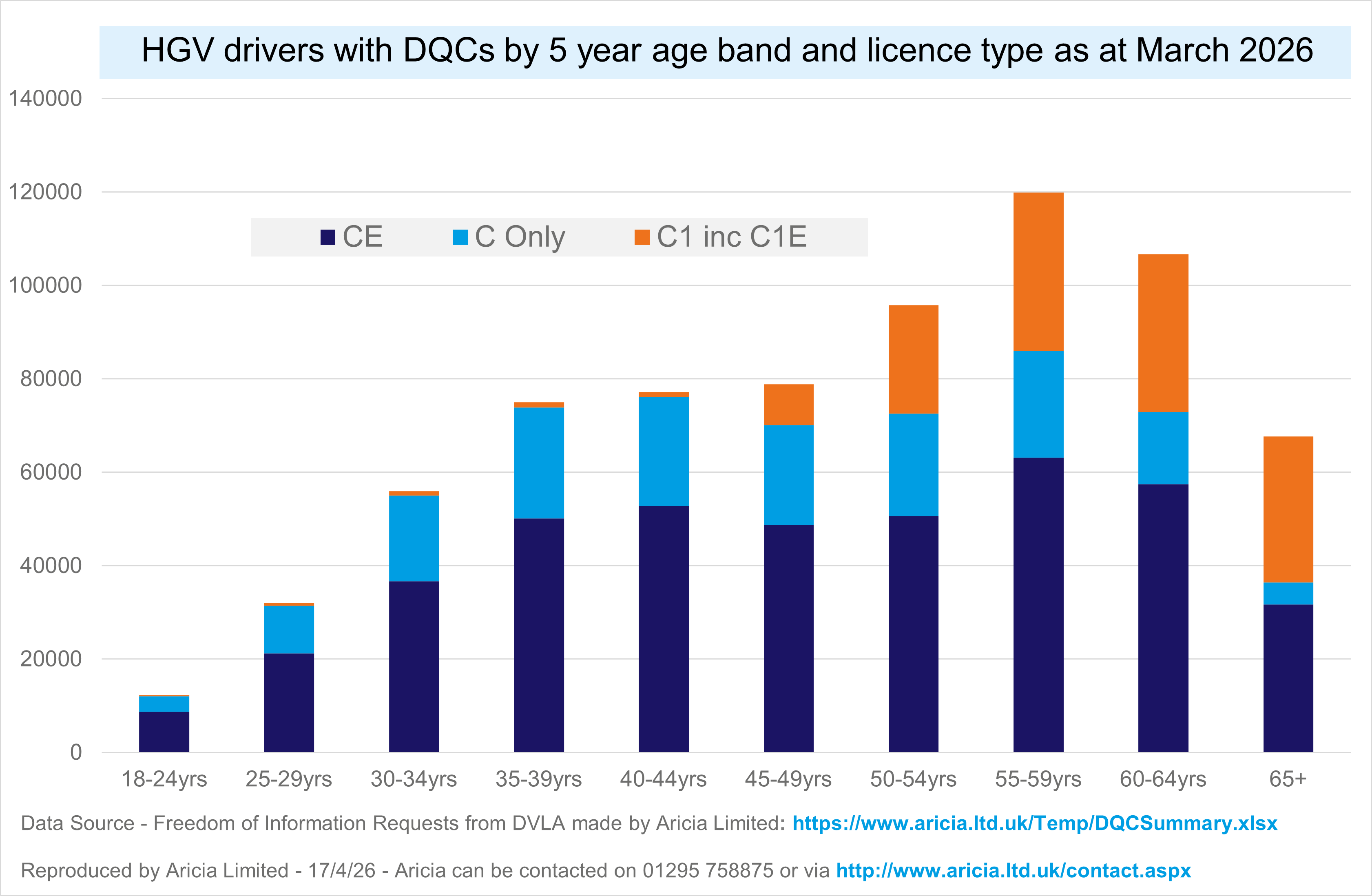
There is a heavy reliance on older drivers, and not enough younger people coming through to replace them.
That’s particularly visible in C1 drivers (shown in orange), where historic licensing rules created a very specific age profile. But the broader pattern holds across vehicle classes. Even with the dark blue (CE = artic drivers) and bright blue (C = big rigid drivers), the shortage of younger drivers coming through as older drivers retire can be seen. We are not replenishing the workforce at the rate we are losing it.
Most operators can feel this already. The drivers you rely on most are often the ones with the most experience. And many of them are closer to retirement than the start of their careers.
As decarbonisation progresses, this challenge may deepen.
- Batteries add weight, which can reduce payloads
- More vehicles may be needed to move the same volume
- Charging or fuelling constraints can affect shift patterns
All of which has a knock-on effect on productivity.
So this is not just a driver shortage, but a driver shortage potentially compounded with reduced productivity.
And unless it is addressed, it will continue to feed directly into:
- service reliability
- available capacity
- and the complexity of operational planning
The Wider Logistics Skills Gap: What’s Changing and Why It Matters
It’s easy to focus on drivers, because the shortage is visible. But the skills gap in logistics is much wider than that.
I remember looking at ONS data on occupational skills a while back[1], and one of the things that struck me was how different the skills mix looked to what you might expect today.
Some of the examples still stick with me.
“‘Speech recognition’ for transport clerks which doesn’t refer to voice technology like Alexa or Siri but the ability to accurately understand and process verbal instructions often given by phone or radio, in busy environments and often involving complex location details, accents and industry terminology
“Getting information” for delivery drivers and couriers.
At the time, those made perfect sense. Busy traffic offices, constant phone calls, drivers piecing together local knowledge from whatever sources they could find e.g. estate agents or the local postie.
Today, much of that has changed.
So the question becomes: what is moving up the list?
Increasingly, it’s:
- technical capability linked to new vehicle types
- data management, analysis and interpretation
- digital systems understanding
- the ability to make decisions in more complex environments
The sector has always been very strong at developing practical, operational capability. That remains a strength.
But the balance is shifting. It’s no longer just about having enough people. It’s about having the right mix of skills.
Decarbonisation Skills: A Growing Constraint on Progress
Engineering maintenance is a major pressure point.
Different vehicle technologies bring different requirements:
- high voltage systems
- fuel cells
- hydrogen handling and safety
- new maintenance processes and standards
These are not skills that exist widely in traditional HGV maintenance workforces.
What we are seeing is a shift from mechanical capability towards electro-technical capability, and it is happening faster than training pipelines can respond.
And it’s not just a logistics problem
The same skills are in demand across:
- utilities
- renewables
- data centres
Which means competition is intense. There is a risk here that doesn’t get talked about enough. If the capability isn’t there, decarbonisation doesn’t just slow down. It can start to constrain capacity.
And there are completely different technical, safety and compliance requirements for transport management. This could be positive for the industry, requiring it to look away from its traditional narrow demographics, away from people with ‘diesel in their blood’ to a wider pool of workers and management. But without targeted transition support, decarbonisation risks shrinking the supplier base, not modernising it. It can make the system less resilient rather than more.
So while the focus is often on vehicles and infrastructure, the reality is this is just as much about people.
Digital and Data Skills in Logistics: From Nice-to-Have to Core Capability
At the same time, the role of data in logistics has fundamentally changed.
Data management, analysis and interpretation are no longer add-ons. They are central to how operations run.
Data is coming from everywhere:
- telematics
- driver apps
- customer systems
- finance platforms
And it needs to be brought together, understood and used properly.
That means being able to:
- look backwards and understand what went wrong and why
- look forwards through planning and predictive insights
- respond in real-time when disruption happens
It also means knowing when not to trust the output. When something doesn’t look right. When a system is technically correct but operationally misleading.
That judgement is still human.
For larger organisations, building that capability is challenging but achievable.
For the >90% of smaller operators across the sector with less than 10 employees[2], it is a much bigger leap. The industry has traditionally been built on experience and practical delivery, and has been very good at promoting people who are operationally intelligent but less academic. It has needed doers more than analysts.
Now it needs both.
How Skills Shortages Are Affecting Capacity, Reliability and Planning
This is where it all comes together.
Skills shortages don’t sit in isolation. They show-up in how the operation performs.
On reliability, you see it in missed windows, last-minute changes and greater reliance on contingency.
On capacity, you see it in vehicles that can’t be fully utilised, or fleets that look sufficient on paper but are constrained in practice.
On planning, you see it in reduced flexibility, more complex scheduling, and a shift away from optimisation towards risk management.
Planning used to be about getting the best possible outcome.
Increasingly, it is about making sure things don’t go wrong.
The People Challenge: Why This Isn’t Going Away Quickly
We need more drivers. We need more engineers. We need more technical capability. And we need managers and planners who can operate in a more complex, data-driven environment.
At the same time, the sector has historically drawn from a relatively narrow talent pool.
As Amy Stokes, Decarbonisation Director at Volvo Trucks UK & Ireland, was quoted recently in Motor Transport[3] as saying: “For too long recruitment in this sector has been hindered by a less diverse applicant pool, making it harder to build an inclusive workforce.”[4] With recruitment hindered by a less diverse applicant base you are unlikely to solve a growing problem by looking in the same places.
There is an opportunity here to rethink how the sector attracts and develops talent.
But without that shift, the underlying pressures are likely to persist.
Conclusion: Logistics Is Not Short of Demand, But It Is Short of Capability
The logistics sector is not running out of work.
If anything, the opposite is true. Demand, complexity and expectations are all increasing.
What is becoming constrained is the ability to deliver.
Driver shortages remain central, but they now sit alongside:
- engineering capability gaps
- digital and data skill shortages
- wider shifts in the type of workforce the sector requires
Taken together, this is no longer just a labour issue.
It is a capacity issue.
It is a reliability issue.
And increasingly, it is a commercial issue.
The sector cannot afford to remain reactive. Because the question is no longer just whether the work is there.
It is whether we have the skills to deliver it. My next article will take a closer look at the demographics of the industry.

Data sources include:
[1] https://www.ons.gov.uk/employmentandlabourmarket/peopleinwork/labourproductivity/datasets/skillssupplyestimates2012to2023
[2] https://assets.publishing.service.gov.uk/media/66fd22b130536cb927482a92/dft-understanding-the-road-freight-market.pdf
[3] https://motortransport.co.uk/industrys-talent-pool-could-narrow-unless-diversity-is-embraced/90142.article
[4] https://motortransport.co.uk/industrys-talent-pool-could-narrow-unless-diversity-is-embraced/90142.article
Logistics Talent That Keeps You Moving
Skills shortages are now limiting capacity, reliability and planning across logistics. From drivers and engineers to planners, managers and leaders, the right capability is critical. Blue Arrow Logistics delivers talent at every level, helping you stabilise today’s operations and build a stronger, more resilient workforce for tomorrow.