Digital Logistics, AI and the UK Industrial Strategy: What It Really Means for Transport and Warehousing
How data, automation and decarbonisation are reshaping logistics, and why readiness matters.

In a month when the IMF (International Monetary Fund) upgraded its estimate for growth in the UK, the government’s investment in the UK’s Modern Industrial Strategy continues to be important, to help counteract the impact of the Iran war and domestic uncertainty.
It’s clear where the UK government’s thinking is going – in the recent industrial strategy document, ‘digital’ gets 54 mentions, ‘artificial intelligence’ and ‘AI’ get 98 combined, and ‘data’ gets 113.[1] The industrial strategy even mentioned logistics specifically in this context: “Enhancing access to transport and logistics data can improve supply chain capabilities and resilience, ensuring UK businesses and consumers have access to the goods they need”. The strategy also promises a new plan for freight and logistics later this year.
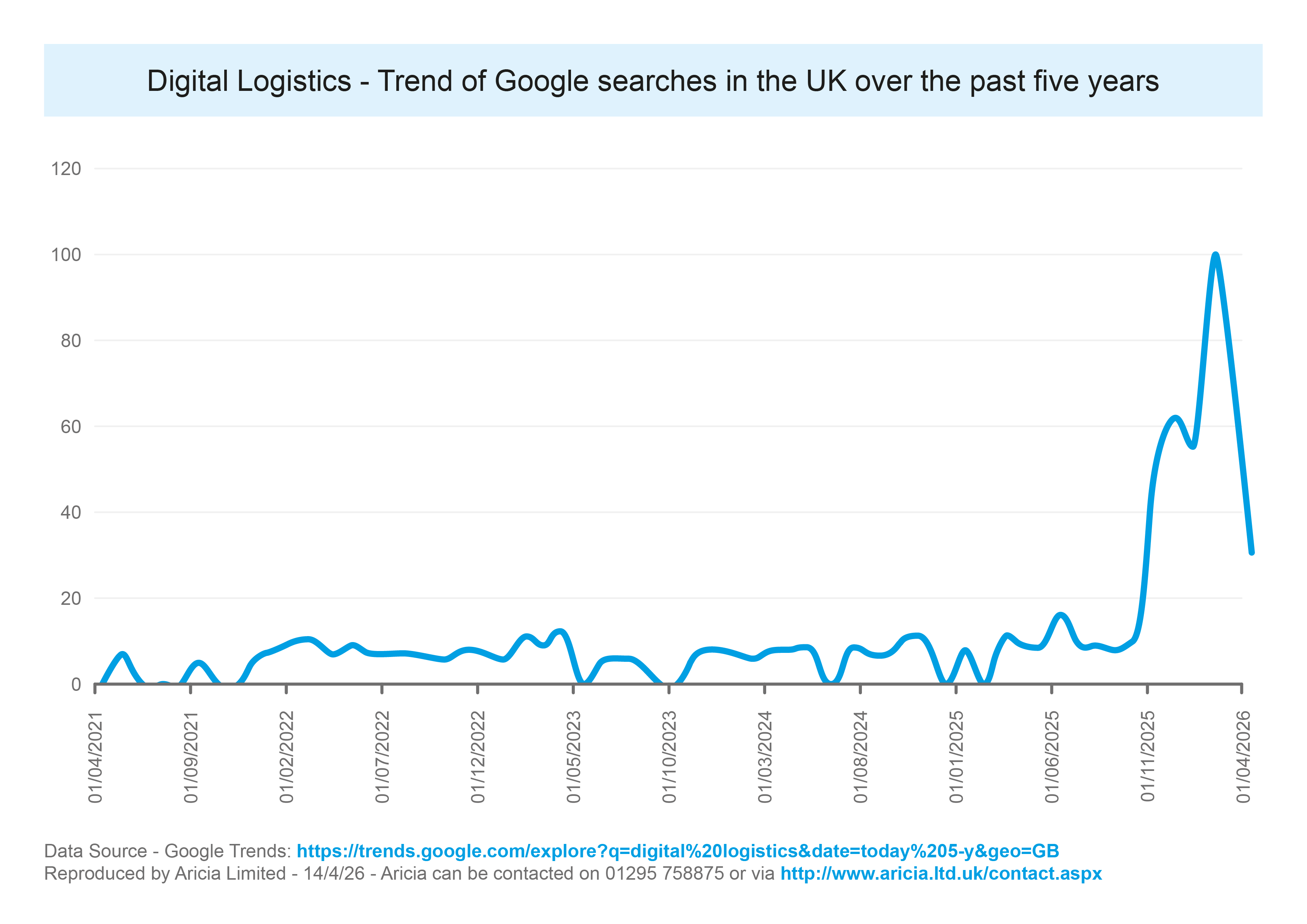
And it appears that more and more people in the UK are also interested in digital logistics (see the graph), although possibly not because of the government’s strategy![2]
In a flurry of interest that led to the Financial Times titling a subsection of one of its Alphaville articles “Trucking Hell”, apparently a single press release from a small company in the US about an AI initiative which had boosted customers’ freight volumes more than 300% without a corresponding increase in operational headcount had knocked c7% off the Russell 3000 Trucking Index in one day![3]
And while that volume benefit may sound a bit juicy, perhaps it’s not. Decathlon's Northampton warehouse is now said to be more than three times as efficient as it was pre-automation – but no-one lost their job due to the robots arriving.[4]
Where AI Is Actually Being Used in UK Logistics Today
That concept of using technology to grow the business with the same overhead, but not discarding long-valued employees, will be a really important one. Analysis of transport costs and rates has suggested that a focus on non-operational costs is required. Digital technology and AI will help medium-sized operators avoid the need to take on more support staff to expand.
The UK is a country very reliant on national and international transport – think food, think clothes, think cars… But logistics sometimes lacks confidence, and that’s understandable as it’s so often dependent on what the rest of the world is doing, whether that be demand levels due to various supply chain disruptions, the cost-of-living crisis, key operating costs such as diesel, government legislation… It can tend to be a sector that has things ‘done to it’, rather than being able to lead the way.
And nowhere is that more so than digital logistics and artificial intelligence. I was really struck by one of the latest waves of data in the ONS Business Insights & Conditions Survey (BICS). There were questions about the use of AI, which types, how were they being implemented, what was their impact on roles and headcount, and so on. Out of 14 questions asked, Transport & Storage businesses were more likely to answer that they were ‘Not Sure’ than any other sector, with only Arts & Entertainment less sure on the first key question.[5] And that’s when potential answers often included that a business was not using that particular aspect of AI or that the question was not applicable.

The specific AI areas the ONS survey asked about included: autonomous vehicles and robotics as well as machine learning, and the sorts of AI that everyone has been experimenting with, namely, text generation and visual content creation. Perhaps it’s some of the jargon which is off-putting.
But before logistics companies can run, they need to be able to walk. Attending a recent conference, George Lynch of NashTech, a man who has been involved with this sort of technology for many years, described much of the current focus as an AI hammer looking for an AI-shaped nail. A big focus of this conference was on getting your house in order before applying AI.
Digital First: Why Logistics Has to Walk Before It Can Run with AI
You need to have digital logistics before some of the most interesting elements of AI can be applied. Warehousing will be ahead of transport in this area, because so much more of warehousing relies on computerised systems while transport still had T-cards in the traffic office. But there are plenty of driver-friendly digital tools these days, although the younger your drivers and transport managers, the more friendly the tools will seem. Older drivers have already had to adapt to tools like the digital tachograph, and while some systems such as telematics often run in the background rather than requiring active input, they can still feel like a loss of independence.
You have to collect the data in a digital way - no use having paperwork for defects, delivery notes & PODs, driver & customer feedback… You then need to clean the data – are those funnies real or errors (ask me about what happened when a colleague and I got Coca Cola in a keyboard in the very early days of having access to computers). And then you need to apply machine learning to that cleansed data. So, we’re getting ahead of ourselves.
But digitising is a great start as it makes it easy to make everything available to everyone – that visibility we’ve talked about for decades. And it allows for automation – not just physical automation, but automation of tasks, even before AI – cutting time, improving speed… And in areas such as dealing with government departments, using alternative routes – changing direction on the fly. In a webinar I attended recently, organised by the IRU, Hasan Boz, Deputy Director General of the Turkish Ministry of Transport & Infrastructure, referred to the resilience during international crisis that had come from digitalisation of logistics.
Decarbonising Logistics: The Overlooked Systems Behind Net Zero
Another focus for the UK’s Modern Industrial Strategy which is already impacting logistics is decarbonisation. The phrase ‘clean energy’ gets 54 mentions, ‘net zero’ gets 30, ‘carbon’ 28 mentions.
Published by DESNZ (Department for Energy Security & Net Zero) last month, the latest estimates are that 31% of the UK’s greenhouse gas emissions in 2025 came from all forms of domestic transport.[6] Of that, approximately 16% will have come from HGVs (2024 publication based on 2023 figures), which means that just under 5% of GHGs come from HGVs.[7] No-one aims to be profligate, but the vast majority of HGVs run on diesel. Alternatives, if not in their infancy, are still only ‘junior’ compared with granddad.
And greenhouse gases are generated by all sort of other elements of logistics – keeping food cold or frozen, keeping pharmaceuticals at the right temperature, maintaining a sensible environment for workers, or to run robots or other equipment… Of course, much of the energy to run a warehouse comes from electricity, so the focus here is not so much on changing fuel, as procuring from clean sources and reducing consumption. But it will also be about how your operatives get to that remote industrial estate.
What This Means for the Future of UK Logistics
While logistics has to be a follower in some respects, it can also be a leader – it has been (think outsourced logistics), it is (think ecommerce) and it must continue to be so. But, in the future, technology, along with energy cleanliness, will become even more important and may well be the decider in who to use, be that 3PL, haulier or driver – if you’re not up to date, then you may be back of the queue!
The Industrial Strategy sets a clear direction, but logistics cannot remain a sector that change simply happens to. If it cannot articulate the systems, skills and investments it needs with confidence, it risks being planned around rather than recognised as a strategic partner.
The next in this series of insight pieces will be on skills shortages. Going back to that ONS survey, 83.2% of Transport & Storage companies were unsure of likely impact of AI on headcount. Logistics is an industry that is always highlighting employee shortages, but with difficulty identifying how many people and with what skills, the case presented to government is not likely to be a convincing one. Time to look forward.

Data sources include:
[1] https://assets.publishing.service.gov.uk/media/69256e16367485ea116a56de/industrial_strategy_policy_paper.pd
[2] https://trends.google.com/explore?q=digital%20logistics&date=today%205-y&geo=GB
[3] https://www.ft.com/content/d52b97ba-8199-4877-b210-e7575cbdcaf2
[4] https://www.bbc.co.uk/news/articles/cp32zk4lpz4o
[5]https://www.ons.gov.uk/releases/businessinsightsandimpactontheukeconomy2april2026
[6] https://www.gov.uk/government/statistics/provisional-uk-greenhouse-gas-emissions-statistics-2025/2025-uk-greenhouse-gas-emissions-provisional-figures-statistical-release
[7] https://www.gov.uk/government/statistics/road-freight-statistics-2024/overview-of-the-road-freight-sector-2024
Leaders Who Move Logistics Forward