Umbrella Risk in Logistics: Protect Your O Licence, Your Margins and Your Eligibility to Bid

From 6th April 2026, HMRC can recover unpaid PAYE and NICs from the recruitment agency that supplies workers engaged through umbrellas, or from the end-client where no agency sits in the chain. This is a structural shift. Add operator licensing obligations and new public procurement exclusion powers, and the risk profile for transport and logistics leaders changes materially. Act now to audit your labour supply chains, tighten controls and reduce exposure.
What Is Changing in Umbrella Company Legislation?
The taxman (or woman – all genders are available) knocks on your door. How do you feel? Compliant and confident? Or are you sweating a little and wriggling in your seat?
There’s a variety of legislation and advice around a whole raft of related employment situations and issues: self-employment, IR35, Limited companies, tax avoidance, umbrella companies, O-licencing… This article is about umbrella companies, because that is where the current changes are taking place, in conjunction with the focus on outsourcing in the Employment Rights Act 2025.
Why Umbrella Risk Is Different in Transport and Logistics
O-licence obligations and umbrella employment overlap
These changes affect many more people than just HGV drivers or logistics staff, but there are some additional aspects that are specific for HGV drivers. So, before we look at the main topic, it’s important to address that difference, namely that HGV drivers work for companies with O-licences, which means that their operations are subject to additional legislation and requirements.
If you imagine a Venn diagram with the O-licence requirements on one side and HMRC’s requirements on the other, then HGV drivers are in the Venn overlap. There’s a recent, very readable LinkedIn post, by consultant Steve Rounds, that describes these overlapping requirements. [1]
Why HGV Drivers Sit at the Centre of HMRC and Traffic Commissioner Scrutiny
Good repute risk and Traffic Commissioner enforcement
Beware potential risks to your good repute. Traffic commissioner, Kevin Rooney, addressed this issue at a Logistics UK Transport Manager Conference in 2024, as reported in Transport Operator at the time:
…the TC reminded delegates that it was illegal to engage self-employed drivers. As transport managers, they had to exercise continuous and effective control over drivers.
“It is a question of control. You cannot tell a self-employed person how to do their job, therefore you are not in control.”
Drivers who had set themselves up as limited companies were even worse, legally.
“A limited company driver is legally controlled by his limited company which is the ‘user’ of the vehicle he is driving, so the limited company will require an O-licence.
“If you are still using limited company drivers, you need to stop! …all your drivers will need to be on the books… or your licence will be revoked.” [2]

Interpreting HMRC Changes Alongside Other Regulatory Duties
After this introduction, this piece will refer to the changes to HMRC rules but as described above, it’s important not to think that these are the only applicable rules. This piece is not intended as legal or financial advice, so make sure what you’re reading is up to date as people have been writing about this topic for years, during which the interpretations of the different players have changed and developed.
What Is Changing in Umbrella Company Legislation from April 2026?
HMRC Paye and NIC Recovery Powers Explained
HMRC will be taking a much stricter approach by changing responsibilities around using umbrella companies. The objective is eliminating tax avoidance and non-compliance. These changes as of 6th April 2026, will already be in place by the time you read this.
While recognising the legitimate role of compliant umbrella companies, significant reforms make recruitment agencies and end-clients (if no agency is involved) liable for unpaid PAYE and National Insurance Contributions (NICs) if an umbrella company fails to pay them. HMRC will be able to recover these taxes, even if the agency or client acted in good faith and undertook due diligence.
There are some useful links on the government website and at the time of writing there is an open consultation on temporary work. [1] [2]
What Is an Umbrella Company Under the 2026 HMRC Definition?
An umbrella company employs workers either on behalf of an agency or the business the employees work for (the end client). Umbrella companies have the same legal responsibilities as an employer for employment rights and the liability to HMRC for: PAYE Income Tax, student loan repayments and both employee and employer National Insurance Contributions. HMRC acknowledges that many umbrella companies operate diligently, providing administrative benefits for agencies and contractors. [3]
Mini-Umbrella Companies and Tax Avoidance Risk
The Scale of Umbrella Non-Compliance in the UK Labour Market
There are also what HMRC describes as mini-umbrella companies (MUCs), which claim incentives aimed at helping small businesses (even though they are part of larger groups), and build up tax debts or fail to send tax returns and then disappear, leaving workers pursued for unpaid tax and HMRC out of pocket. [4]
Financial and Legal Risks for Recruitment Agencies and Logistics Operators
The nature of the problem depends on who you are: a driver, a logistics manager, HMRC and the government, a recruitment agency, an end client or the umbrella companies themselves.
The Problem for HMRC and the Government
HMRC estimate that this type of tax fraud is costing an average of £500m per year. See the graph below for the amounts that it envisages recouping over the next 5 years.
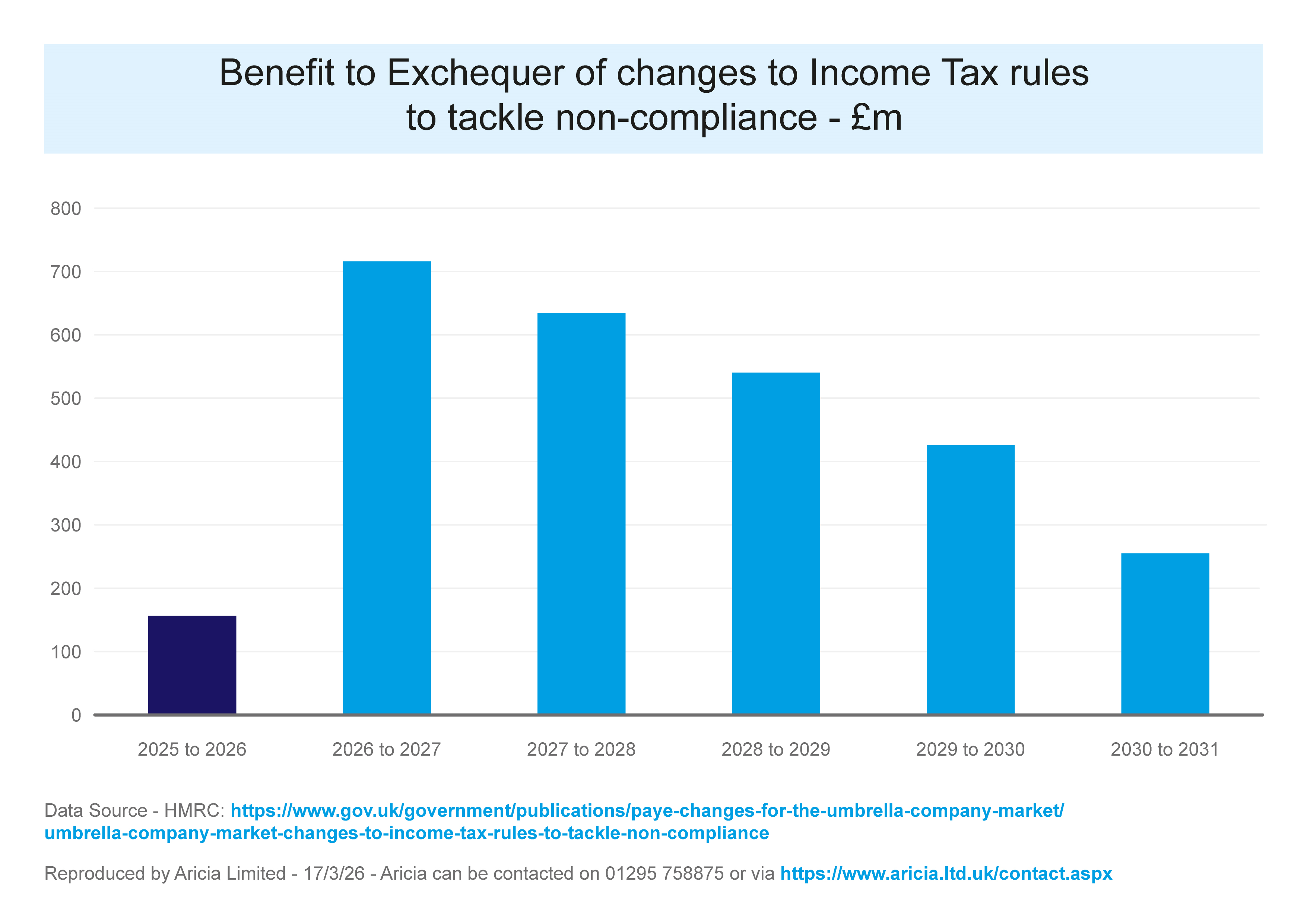
It’s difficult to imagine what £500m looks like? 10 million fifty-pound notes - still difficult to imagine. What about seven million potholes filled, and hopefully dealt with? That’s what the government has recently made available to local authorities to deal with this issue - I think we can all agree that HMRC needs to recoup this money! [1]
Impact on HGV Drivers, Pay Structures and Employment Models
Key Information Documents and Worker Transparency
It’s not just drivers that might be employed under umbrella arrangements - it could also affect other staff.
You may see your pay reduce if you were part of a previous scheme deemed unsatisfactory. You may be asked to move to a different umbrella company (for example an FCSA accredited one), or on to PAYE - many companies are now wanting PAYE workers, not those employed through umbrella companies, because of how HMRC can now chase end clients for unpaid taxes. [2]
On the plus side, going forward, you could avoid “a multitude of problems ranging from a lack of transparency over core terms and conditions such as pay rates, to unwittingly becoming embroiled in fraudulent tax arrangements with serious financial consequences”, as described by the TUC. [3]
Since 2020, by law, you should receive a KID (Key Information Document) if you’re working through an employment business, and the government website has useful information about what to look out for to ensure you’re not involved in tax avoidance. [4]
What HMRC’s New Recovery Powers Mean for Agencies and End-Clients
Joint and Several Liability Explained for Agencies and End-Clients
Although the initial responsibility for PAYE remains with the umbrella company, in the case of tax not being paid, from April 2026, HMRC can now look up the chain to the recruitment agency (or end client if there is no agency) to recoup that money. As well as using accredited providers, agencies are advised to use third-party auditing tools to verify that tax is actually being paid to HMRC. But the risks go beyond HMRC demanding money…
Public Procurement Risk and Exclusion under the Procurement Act 2023
Commercial Risk: Margins, Contracts and Bid Eligibility
Some of the other legal risks are described in this piece on the REC (Recruitment and Employment Federation) website: “Companies involved with non-compliant Umbrella Companies may also face debarment or exclusion from public sector contracts under the Procurement Act 2023, particularly if tax evasion or fraudulent activity is linked to their supply chain.” [5]
What the Changes Mean for Umbrella Companies Themselves
The implications for the umbrella companies themselves aren’t the focus of this article, but HMRC is actively working to identify "mini-umbrella" companies as part of its compliance drive. And there are likely to be further regulations to ensure workers receive proper protections.
This is expected to impact on about 400 umbrella companies.[6]
On the government website, there’s a page titled: "Current list of named tax avoidance schemes, promoters, enablers and suppliers" - the word "umbrella" was mentioned 446 times when it was updated on 12th March 2026.[7]
How Big is the Umbrella Risk Exposure in the Logistics Sector?
How many HGV drivers are working under the auspices of umbrella companies? We don’t know. Part of the problem is the lack of statistics around this issue, and where figures exist, they are for all sectors and not particularly up to date.
HMRC reports from 2022/2023 indicate that umbrella companies were used to engage at least 700,000 workers, at least 275,000 of which were engaged at some point by umbrella companies that failed to comply with their tax obligations – this is across all sectors. [8]
When this all unfolds, what will happen to pay rates? And what will happen to driver numbers? How many people will leave the industry if the pay rates don’t reflect what they’ve been receiving in their pay packets previously? And that will be on top of the 100K+ drivers that didn’t update their DQCs recently, although they may not have been using their licences anyway, for whatever reason - they may have been working in a different industry, promoted, sick, studying…
Much as I love figures and forecasts, it’s impossible to assess the potential impact on logistics right now.
What Logistics Leaders Should do now to Reduce Umbrella Risk
Auditing your Labour Supply Chain for HMRC and O-Licence Compliance: What Good Compliance Looks Like
Start by asking some questions. Many companies are now wanting PAYE workers, instead of those employed through umbrella companies. Ask yourself: Why? And if you’re going to use umbrella companies, what do you need to do to keep yourself out of trouble?
Agencies and end‑clients need to identify every organisation in their employment chain and put robust, documented checks in place immediately.
Logistics operators must do the same for all third‑party payroll providers, ensuring any umbrella company used is compliant and actively monitoring PAYE and NIC deductions to confirm they align with standard PAYE treatment.
The government maintains a public list of named tax avoidance schemes and promoters, which should be treated as a baseline reference, not a safeguard. [9]
Joint and several liability means HMRC can recover unpaid tax from you, if another party in the chain fails to pay.
So, returning to the question at the start of this article: when that knock comes, or more likely when the email lands, will you be compliant and confident?
The answer depends on the actions you take now. The buck stops with you.

Data sources include:
[1] https://www.linkedin.com/pulse/ltd-company-drivers-ir35-dangerous-comfort-steve-rounds-pktif/
[2] https://transportoperator.co.uk/2024/09/25/tc-urges-driver-welfare-focus-at-transport-manager-event/
[3] https://www.gov.uk/government/publications/paye-changes-for-the-umbrella-company-market/umbrella-company-market-changes-to-income-tax-rules-to-tackle-non-compliance
[4] https://www.gov.uk/government/consultations/make-work-pay-modernising-the-agency-work-regulatory-framework
[5] https://www.gov.uk/guidance/paye-rules-for-labour-supply-chains-that-include-umbrella-companies-from-6-april-2026
[6] https://www.gov.uk/guidance/mini-umbrella-company-fraud
[7] https://www.gov.uk/government/publications/paye-changes-for-the-umbrella-company-market/umbrella-company-market-changes-to-income-tax-rules-to-tackle-non-compliance
[8] https://www.gov.uk/government/news/pm-tells-councils-to-prove-action-on-pothole-plague-to-unlock-extra-cash-and-reveals-48bn-for-major-roads
[9] https://www.fcsa.org.uk/directory-of-members/
[10] https://www.tuc.org.uk/blogs/government-crackdown-umbrella-companies-will-protect-workers
[11] https://www.gov.uk/guidance/key-information-document-guidance-for-agency-workers-paid-through-umbrella-companies
[12] https://www.rec.uk.com/recruiters/legal/umbrella-companies-what-agencies-need-know#tabWhat_are_the_legal_risks_of_working_with_Umbrella_Companies_69aecadb81abb
[13] https://www.gov.uk/government/publications/paye-changes-for-the-umbrella-company-market/umbrella-company-market-changes-to-income-tax-rules-to-tackle-non-compliance
[14] https://www.gov.uk/government/publications/named-tax-avoidance-schemes-promoters-enablers-and-suppliers/current-list-of-named-tax-avoidance-schemes-promoters-enablers-and-suppliers
[15] https://www.gov.uk/government/consultations/tackling-non-compliance-in-the-umbrella-company-market/outcome/tackling-non-compliance-in-the-umbrella-company-market-government-response-accessible
[16] https://www.gov.uk/government/publications/named-tax-avoidance-schemes-promoters-enablers-and-suppliers/current-list-of-named-tax-avoidance-schemes-promoters-enablers-and-suppliers
Driver Recruitment Solutions