Equality Action Plans Are Coming for Logistics. Most Are Not Ready

April 2027. A client asks for evidence of your Equality Action Plan as part of a tender renewal. Your outsourced labour provider asks what data you need from them. Your board asks whether “we” are compliant.
Most logistics businesses will not be able to answer all three.
The Employment Rights Act 2025 is another area where logistics companies need to listen up, along with all other sectors. Although this is now going to cost employers *just* £1bn each year according to a piece on the BBC website, down from an original estimate of £5bn per annum after the government made major concessions.[1][2]
There are several major changes coming up the back straight: changes to Statutory Sick Pay, Family Leave and the introduction of the Fair Work Agency in April alone. Then, the need to make sure that your workers know their rights with respect to joining a union and increased obligations around harassment later this year, and more to come in 2027 including requirements around zero hours contracts.
The Employment Rights Act is not just a policy shift. For logistics, it represents a new form of operational risk. A sector built on shift work, agency labour and outsourced supply chains is about to be asked to evidence fairness, transparency and control in places it has not historically measured.
This article looks at Equality Action Plans, also part of the Employment Rights Act, and a future piece will examine Umbrella companies, the focus of other new rules from April.
Equality Action Plans
Equality Action Plans are not diversity statements. They are operational documents that show:
- how work is allocated
- who gets access to premium shifts
- how progression actually happens
- where outsourced labour sits outside your visibility
The Employment Rights Act will require employers with 250+ staff to publish annual Equality Action Plans from 2027, with voluntary adoption from April 2026. These plans must include:
- gender pay gap actions
- measurable commitments
- a menopause support plan
- transparency around outsourced labour providers

Guidance on gender pay gaps was published by the government late December 2025, after the act was passed, Closing Your Gender Pay Gap[1]. It contains areas where you can take action if you’re recruiting or promoting staff, to make your organisation more inclusive, and to support your staff. And it also gives advice on how to create an action plan.
And this key guidance gives the dates for the Equality Action Plans (as already noted, voluntary this spring, mandatory for 2027) and expands on other areas that are not included in this act but which the government is looking at, namely a Gender Pay Gap Outsourcing Measure which is part of broader changes to pay gap reporting, including related measures in the draft Equality (Race & Disability) Bill. It seems to have been published in early January, according to its properties.[2]
These new expectations will be challenging for logistics.
The Women in Logistics – Pay and Percentages[3] report published last year, matters because it explains why Equality Action Plans will be harder for logistics than for most sectors.
The gender pay gap here is not driven by pay discrimination. It is driven by who gets access to driving roles, night shifts, overtime and progression. This means Action Plans cannot rely on surface‑level narratives. They require operational change.
Women in Logistics: Pay & Percentages
Last year, Women in Logistics published a report which highlighted very low female representation across logistics, persistent pay gaps, and strong evidence that role mix and shift patterns drive disparities. The report demonstrates that the sector starts from a disadvantage and needs to prepare now.
Some highlights from the report “Women in Logistics: Pay and Percentages (2025)”
- Women remain significantly underrepresented across logistics, especially in operational and higher paid roles (e.g. 1.5% of HGV drivers; 14 - 23% of managers; only clerical roles near parity)
- Pay gaps persist, with over four in five logistics companies reporting a mean gap in favour of men and over 98% majority male top quartiles
- Trends show slow improvement, but shocks like the 2021 driver pay surge demonstrate how sensitive logistics is to market shifts
- Role mix and shift premiums explain much of the gap, not equal pay breaches

To test readiness, fresh analysis was carried out on logistics companies’ most recent gender pay gap submissions. What this shows should worry sector leaders.
Fewer than 3 in 5 companies provided anything resembling context or action on their own websites. Fewer than 1 in 8 showed evidence of defined actions or future targets.
Equality Action Plans require exactly what most did not provide.
Fresh Analysis
The fresh analysis carried out for this article, had to refer to last year as, at the time of writing, only about 1 in 6 companies across all sectors had submitted their gender pay gap data based on April 2025 for the 2026 submission. This is a completely fresh piece of analysis of the 2025 submissions, not published before.
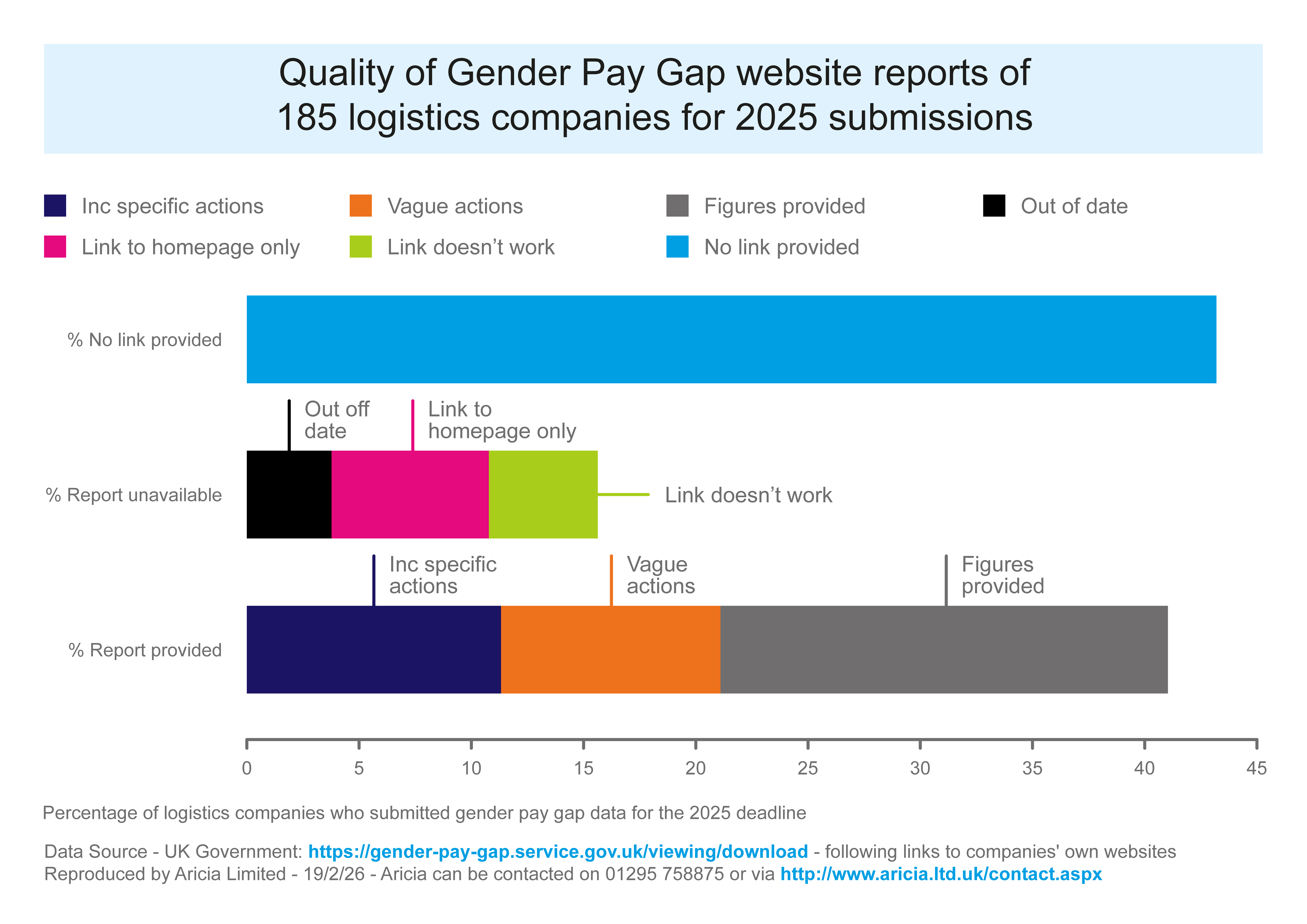
This analysis does not paint a picture of logistics companies being ready to create, monitor and implement their Equality Action Plans. Less than 3 out of 5 of the 185 logistics companies that submitted gender pay gap data last year included any link to their website, and some of those only go to the website front page - you have to have a certain admiration for the cheek of those businesses which have used this opportunity to advertise their company without actually sharing their stats!
To be clear, all companies included in this analysis (including those in ‘% No link provided’ and ‘% Report unavailable’ bars) completed submission of their figures to the government website. This analysis looks at what they have provided on their own websites. Also, again to be clear, where it indicates that figures have been provided (grey bar), this can often include analysis and commentary, but with no action plan.
The companies included in the navy-blue bar (% Report provided) are the only ones who are likely to be ready for what the government is demanding for next year, with specific recent actions or future targets and, in some cases, widening out their analysis to include other elements of diversity, such as ethnicity. Based on past performance, that’s less than 1 in 8 companies that are likely to be ready.
For logistics leaders, early action is not about optics. It is about control. At a minimum, organisations should now be able to action and prepare.
Take Action on Action Plans
The fresh analysis above shows the extent to which logistics companies need to start their thought process on these Action Plans. The Women in Logistics report is a good place to start. This report gives employers everything the government expects them to demonstrate – the report is intended as a practical tool, not just research:
- a data‑driven understanding of why their gap exists
- insight into structural drivers such as job segregation and shift premiums
- evidence on representation gaps and progression barriers
- sector trends that help shape a credible narrative
And in terms of action, there are some simple steps that you can start taking right now:
- Explain your gap using role mix, shift patterns and market pressures
- Set measurable goals to improve female representation in higher‑paid and leadership roles
- Improve access to operations, driving and premium‑shift work
- Prepare for outsourced transparency by identifying outsourced providers and requesting their pay gap data
The challenge for logistics is turning insight into site‑level action, especially where labour is outsourced.
This is precisely why solutions such as Diversify have emerged, designed to translate workforce EDI data into practical, depot‑level interventions across both direct and outsourced workforces.
Diversify
Not only an imperative for logistics companies but Diversify is also the UK’s first EDI‑as‑a‑Service solution developed by Blue Arrow for both outsourced talent communities and direct employees, turning workforce EDI (Equality, Diversity & Inclusion) insight into site‑level actions that improve engagement, retention and performance. Outsourcing of labour, as already mentioned above, also features in the Employment Rights Act.[1]
And Look Forward
Equality Action Plans will expose how well logistics organisations understand their own workforce. Those who act early will enter 2027 with cleaner data, stronger narratives and real control over outsourced labour.
Those who wait will be explaining gaps they can no longer justify. This is not about compliance. It is about whether logistics leadership is ready for the scrutiny that this mandatory reporting will bring.


Data sources include:
[1] www.legislation.gov.uk/ukpga/2025/36/enacted
[2] www.bbc.co.uk/news/articles/c5yv6n536vno
[3] www.gov.uk/government/publications/gender-pay-gap-reporting-guidance-for-employers/closing-your-gender-pay-gap
[4] assets.publishing.service.gov.uk/media/69613479a02fd76bbbc117e6/equality-action-plans-and-outsourcing-factsheet.pdf
[5] https://www.womeninlogistics.co.uk/shop
[6] www.bluearrow.co.uk/recruitment-solutions/diversify/
Driver Recruitment Solutions